Photos:
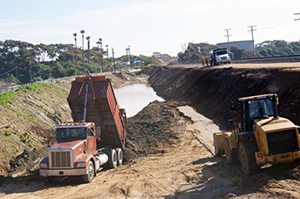
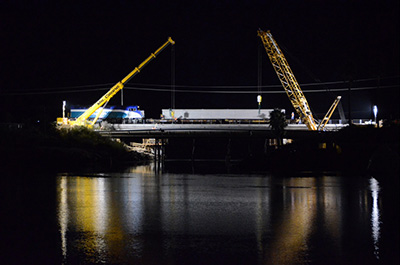
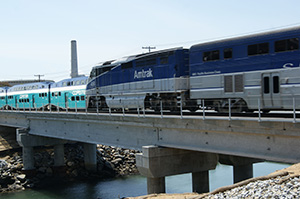
Building the Carlsbad Double Track Project.
Among intercity and commuter rail lines in the United States, the Los Angeles – San Diego – San Luis Obispo (LOSSAN) rail corridor has experienced the most significant growth in terms of ridership and service density since 1990. The corridor hosts intercity services operated as Amtrak’s Pacific Surfliner and commuter rail services operated under the Metrolink and Coaster service marks. During this period, the California Department of Transportation (Caltrans), the LOSSAN Rail Corridor Agency, and county transportation authorities have funded significant capacity improvements to this corridor, focused primarily on double-tracking sections of the main line to allow for increased service densities and speeds.
In 2010, Amtrak broke ground on the Carlsbad Double Track Project. This project, the first Amtrak-funded corridor capacity improvement in the West, was intended not only to improve capacity but also to demonstrate the corporation’s commitment to serving the increasingly competitive market for providing passenger rail services in the region. This $17.1 million project included construction of 1.9 miles of main track, resulting in a 5.1-mile double-track section connecting two existing control points. The project also installed one new control point, constructed a 213-foot concrete bridge, and modified an existing control point by installing two No. 24 turnouts to create a new universal control point to support higher-speed operation. The project was completed ahead of schedule and under budget in February 2012.
I made several presentations on this and other projects on the LOSSAN corridor, explaining the strategies I used to create a cohesive planning and engineering team approach that can be applied to other projects involving passenger corridors and public-private partnerships. The presentations also focused on specific challenges that affected the project’s critical path, such as funding requirements that dictated significant changes to project milestones, the need to minimize service disruptions, and safely working alongside in-service main lines in environmentally sensitive areas.
Planning, Developing, and Completing the Carlsbad Double Track Project
– Presented at the American Railway Engineering and Maintenance of Way Association (AREMA) Annual Conference, September 2012, in Chicago, IL
Successfully Planning and Implementing Railroad Infrastructure Projects That Require Major Service Disruptions
– A Case Study Examination (co-authored with John P. Eschenbach) – Presented at the Transportation Research Board Annual Meeting, January 2013, in Washington, DC, and at the American Railway Engineering and Maintenance of Way Association (AREMA) Annual Conference, October 2013, in Indianapolis, IN
The Santa Margarita River Bridge Replacement Project: Overcoming Construction Challenges in Rebuilding Railway Infrastructure
– A Case Study Examination (co-authored with Michael J. Albanese) – Presented at American Railway Engineering and Maintenance of Way Association (AREMA) Annual Conference, September 2014, in Chicago, IL

All
material appearing on this website, unless explicitly noted otherwise,
is the intellectual property of Thomas C. Cornillie copyright 2012